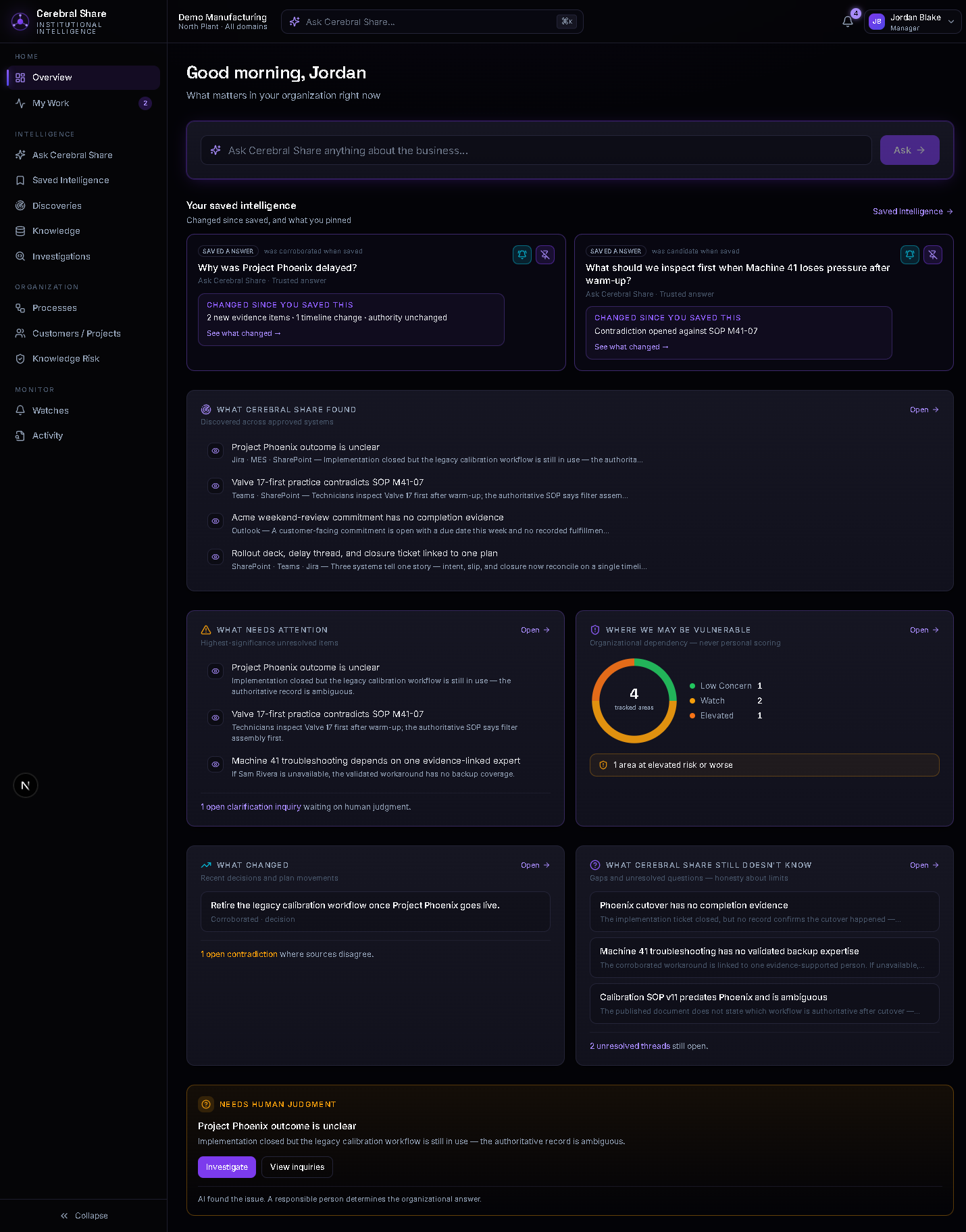
Your company knows more than any one system can show you.
Important business context rarely lives in one place. It is spread across approved conversations, documents, meetings, projects, tickets, files, customer history, operating systems, and the experience of the people doing the work.
Cerebral Share connects that evidence to help your organization understand what happened, why decisions were made, where actual work differs from the plan, what remains unresolved, and what knowledge could disappear when people leave.
The answer may exist. Just not in one place.
A decision might begin in a meeting, change in email, get delayed in Teams, appear closed in a project system, and still never reach the procedure people use every day.
Cerebral Share is designed to connect those fragments.
Reconstruct decisions
Reconstruct why a decision was made, with the evidence that surrounded it.
Plan versus reality
See what was planned versus what appears to have happened.
Connect attachments to context
Connect attachments and documents to the conversations and decisions around them.
Surface the unresolved
Surface unresolved questions or commitments.
Detect guidance drift
Identify where official guidance no longer matches current evidence.
What Cerebral Share helps you see.
Trusted Answers
Get evidence-backed answers and see when no authoritative answer exists.
Investigations & Timelines
Reconstruct what happened, what changed, and what remains unresolved.
Contradictions & Process Drift
Surface where documentation, teams, locations, or current practice disagree.
Knowledge Risk
Identify critical knowledge that may be concentrated, stale, incomplete, or weakly supported.
Meetings Into Intelligence
Turn approved meeting material into decisions, actions, risks, questions, and reusable briefs.
Knowledge That Stays Current
Reassess important intelligence as new evidence appears.
Human-Governed Authority
Keep responsible people in control of what becomes trusted organizational knowledge.
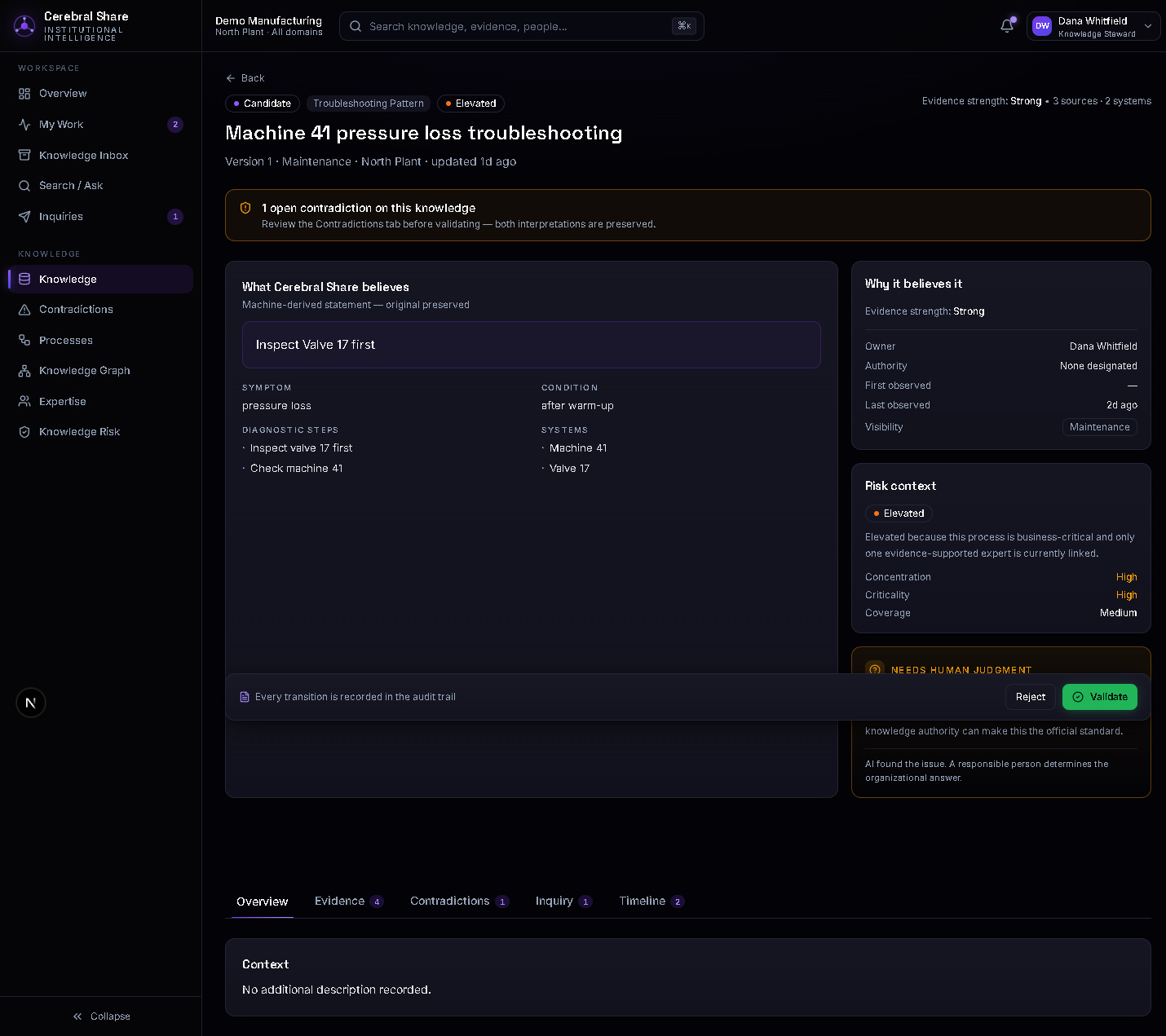
From a hallway remark to trusted organizational knowledge.
A product scenario illustrating how Cerebral Share works in practice. Not a customer case study.
Everyday Work
A maintenance technician mentions in a team channel that Machine 41 always throws the same error after a long weekend shutdown — and that resetting Valve 17 clears it. This is the kind of operational knowledge that rarely makes it into documentation.
Knowledge Identified
Cerebral Share identifies the exchange as potentially valuable operational knowledge worth examining.
Evidence Connected
Supporting maintenance evidence is found: similar mentions in work orders, a note in a shift log, and a parts request history that correlates with the pattern.
Conflict Surfaced
The documented troubleshooting guide does not mention Valve 17 in this context. It says to check the pressure sensor first — which technicians have learned is not the actual fix.
Candidate Created
Cerebral Share creates a candidate knowledge record and highlights the uncertainty instead of pretending the conflict does not exist.
Human Clarification
The appropriate subject matter expert is asked to clarify: the maintenance supervisor receives a focused, evidence-backed review request.
Validated by People
A responsible process owner confirms the workaround, adds safety context, and decides what becomes trusted organizational knowledge.
Trusted & Usable
The validated knowledge becomes searchable and available for approved use — new technicians can find it, and training material can reference it.
Reassessed Over Time
If future evidence suggests a better fix, the knowledge can be reassessed rather than silently becoming outdated.
From everyday work to trusted institutional intelligence.
Observe
Cerebral Share works with approved organizational sources and evidence.
Understand
It identifies potential knowledge, relationships, exceptions, contradictions, and areas of risk.
Clarify
When something important is incomplete or conflicting, the right people can be asked for context.
Validate
Responsible people determine what is accurate and what becomes trusted or authoritative.
Use
Validated knowledge becomes available for search, decisions, training, operations, and approved downstream systems.
Reassess
New evidence can trigger review when knowledge changes, drifts, or becomes stale.
Where this becomes a business problem.
Retirement & Succession
Important expertise may leave before the organization captures what made it valuable.
Operations & Troubleshooting
Critical fixes and workarounds often live outside the official procedure.
Customer Continuity
Years of account context may be scattered across people, CRM records, meetings, and communication.
Acquisition & Integration
Two organizations may use different processes, terminology, standards, and assumptions.
Ready to preserve your institutional knowledge?
What does your organization know that it cannot afford to lose?
You do not need to connect the entire company to begin. Start with one process, customer, role, operational issue, retirement, recurring exception, or area where important knowledge is difficult to find, validate, or transfer.
The time to preserve critical knowledge is before the transition becomes urgent.