Make the knowledge your business depends on visible, reviewable, and durable.
Cerebral Share helps organizations turn important knowledge created throughout approved everyday work into a governed institutional capability.
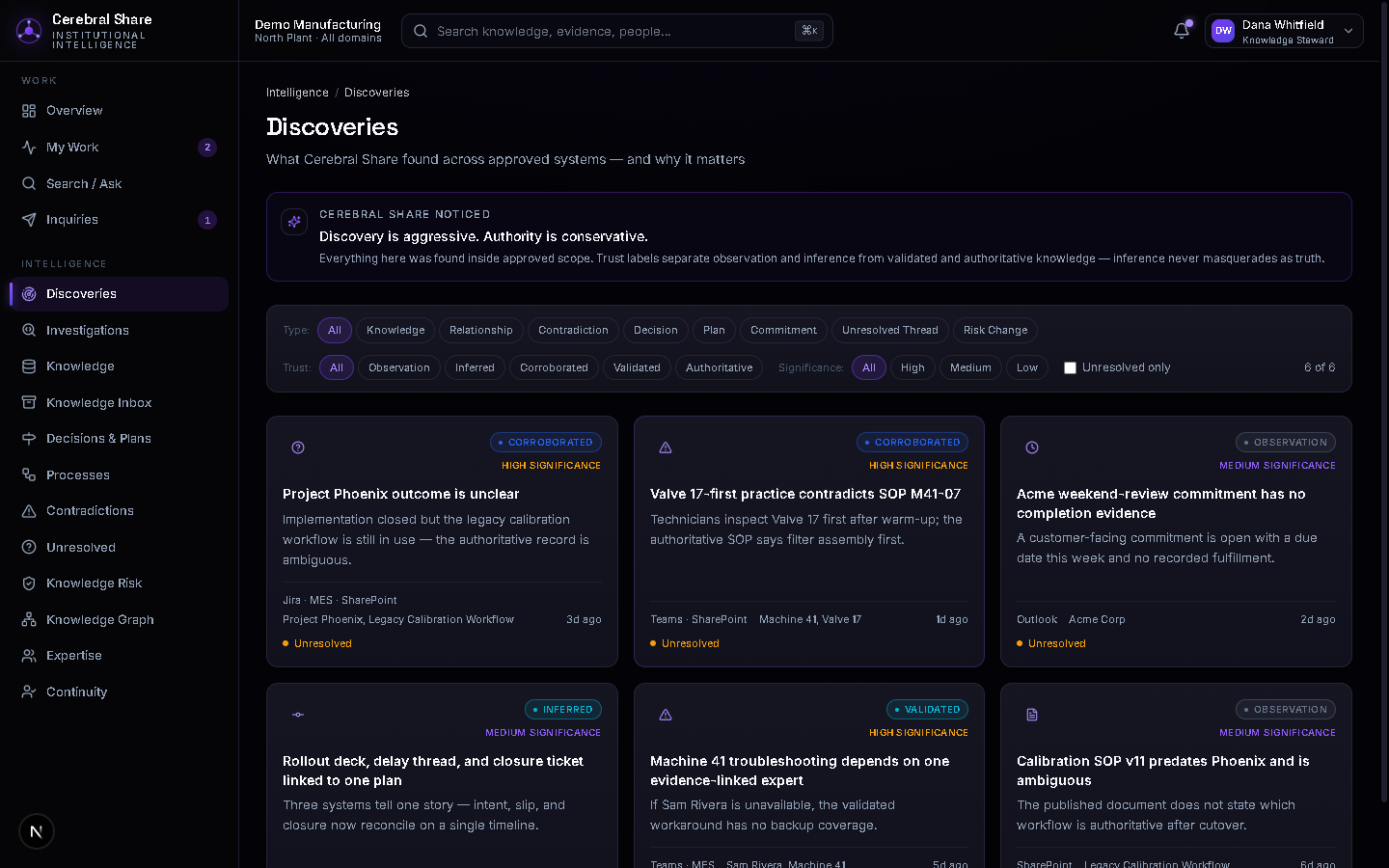
Discover
Identify potential institutional knowledge hidden in everyday work and existing organizational information.
- Procedures and standard work
- Exceptions and edge cases
- Troubleshooting patterns
- Decision rationale
- Warnings and cautions
- Customer nuances
- Process differences across teams
- Lessons learned
Show the Evidence
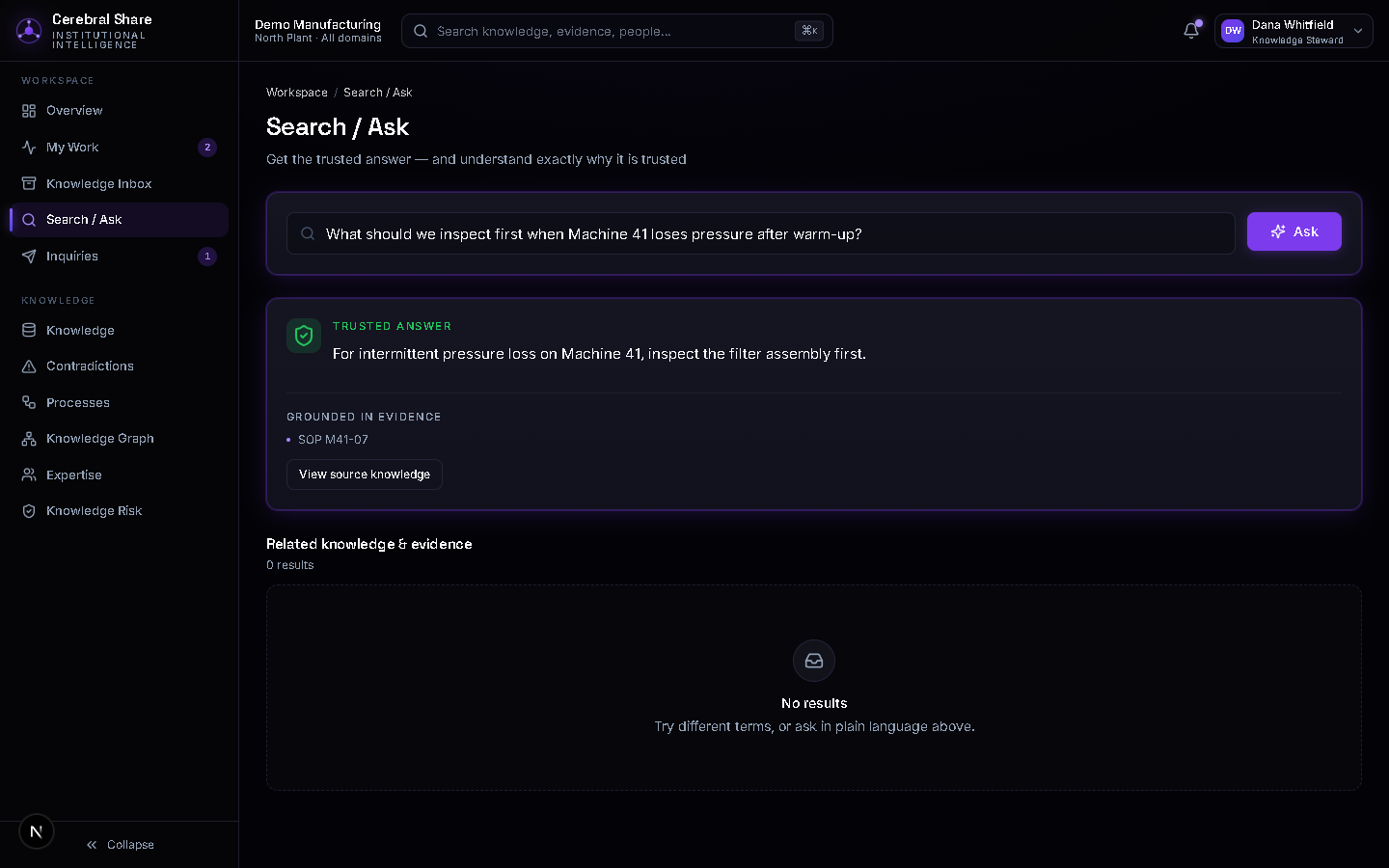
Trusted knowledge should never require “because the AI said so.” Make supporting source evidence, context, timing, and review state understandable.
Every piece of knowledge in Cerebral Share carries its evidence trail. Users can see where it came from, when it was identified, what supports it, and what might conflict with it.
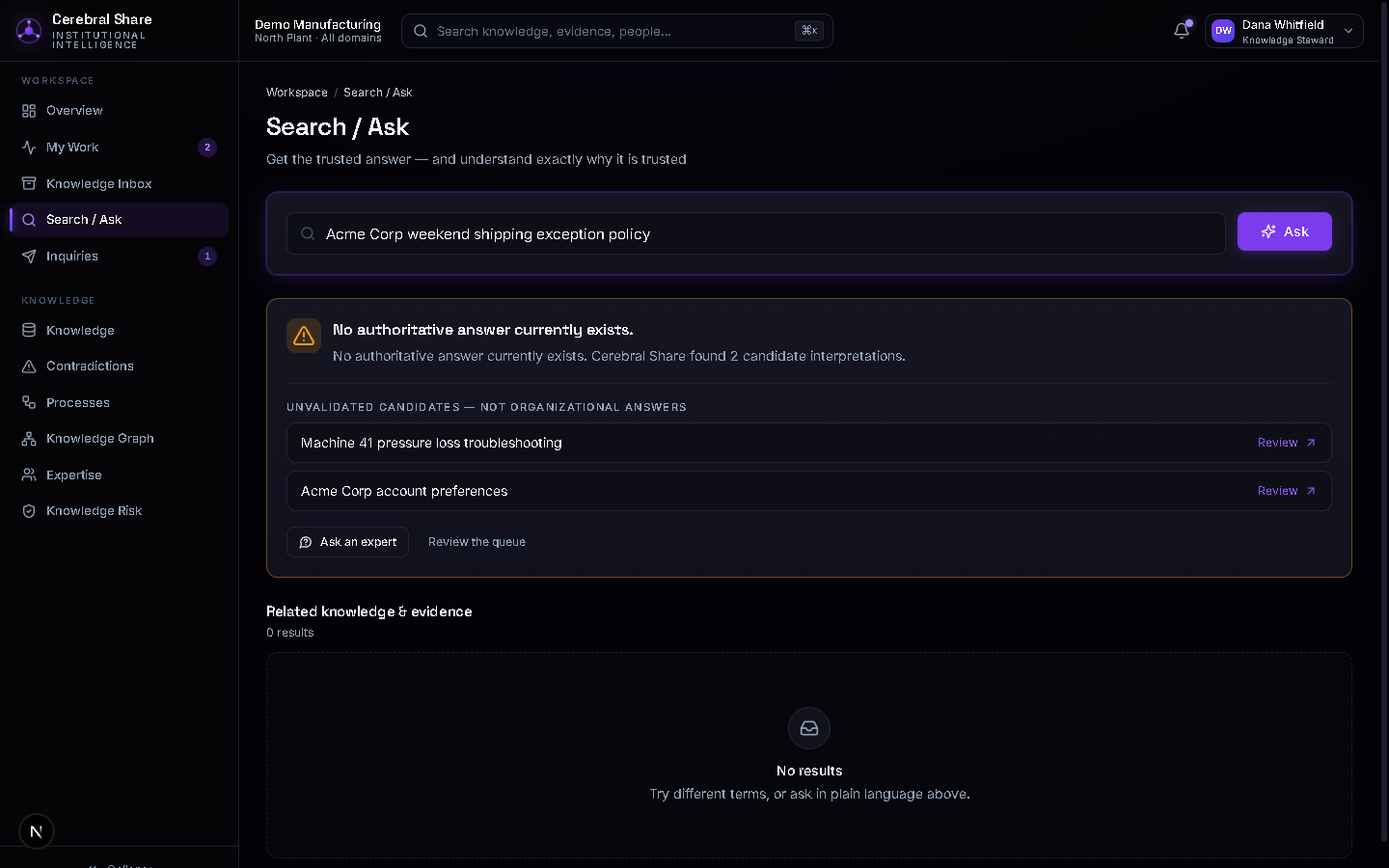
Sometimes the most trustworthy answer is: “We do not know yet.” Cerebral Share is designed to surface uncertainty and say when no authoritative answer exists, instead of manufacturing certainty.
Clarify What Is Missing
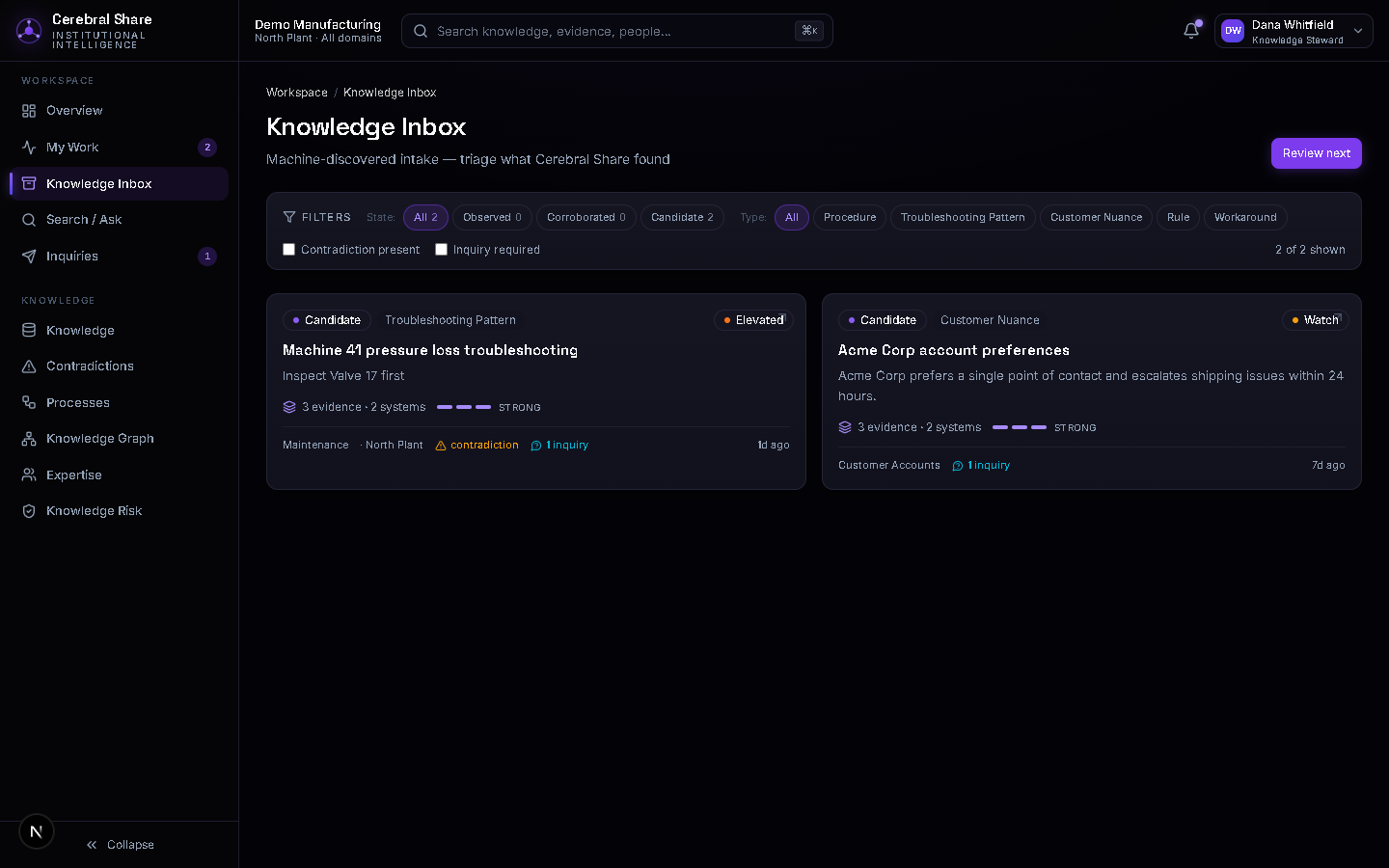
When important evidence conflicts or lacks context, route focused questions to the people most able to clarify it.
Instead of asking experts to document everything from a blank page, Cerebral Share brings them specific, evidence-backed questions where their judgment matters most.
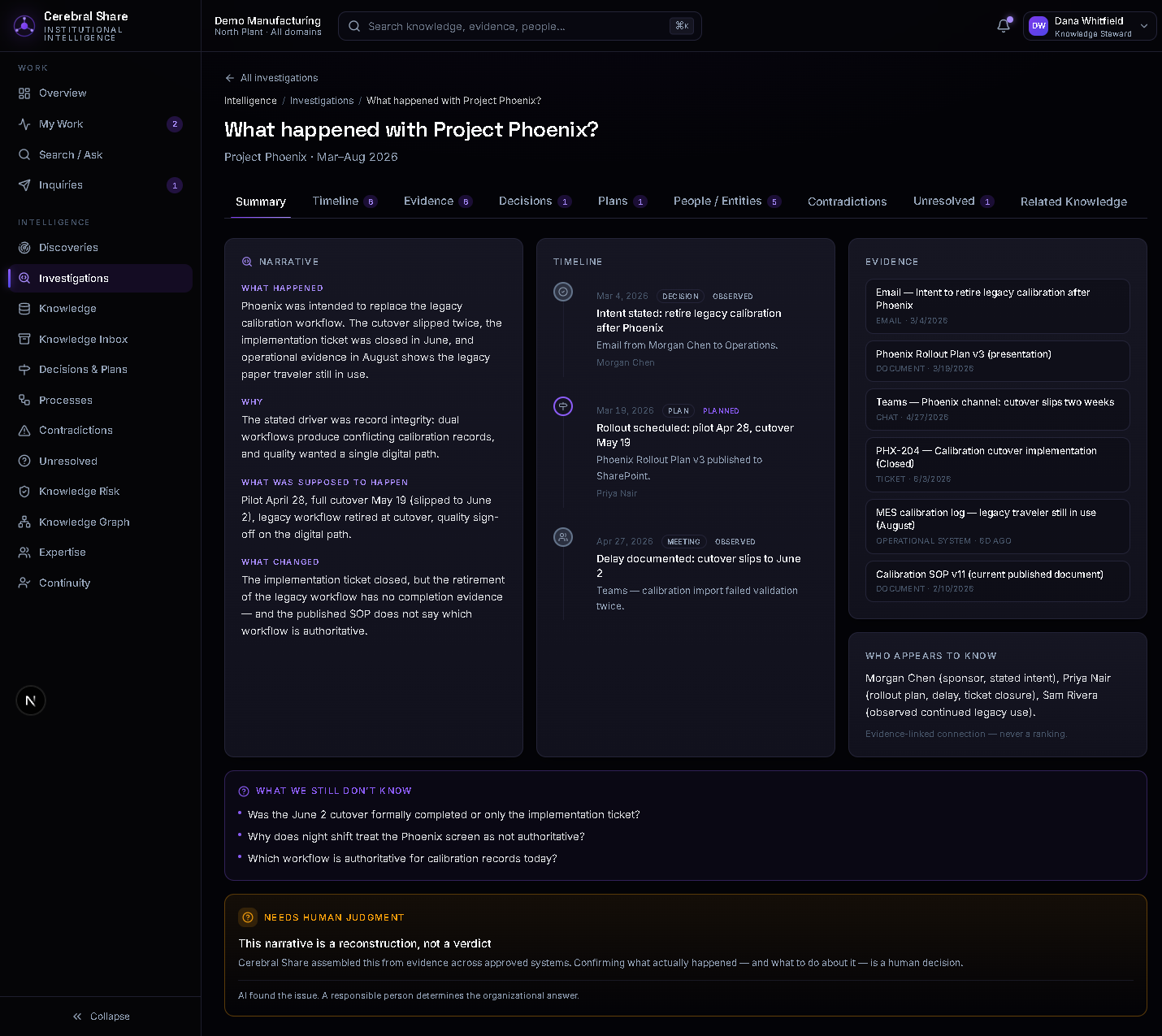
Reconstruct what happened — and what it means
Ask the questions that are almost impossible to answer by searching one system at a time: what happened with this project, why this process changed, what was supposed to happen, and what remains unresolved.
Cerebral Share connects evidence across approved sources into a timeline — what was intended, what was planned, what changed, and what happened afterward — and separates evidence-backed facts from inferred or unresolved interpretations. A reconstruction is presented as a reconstruction, never a verdict.
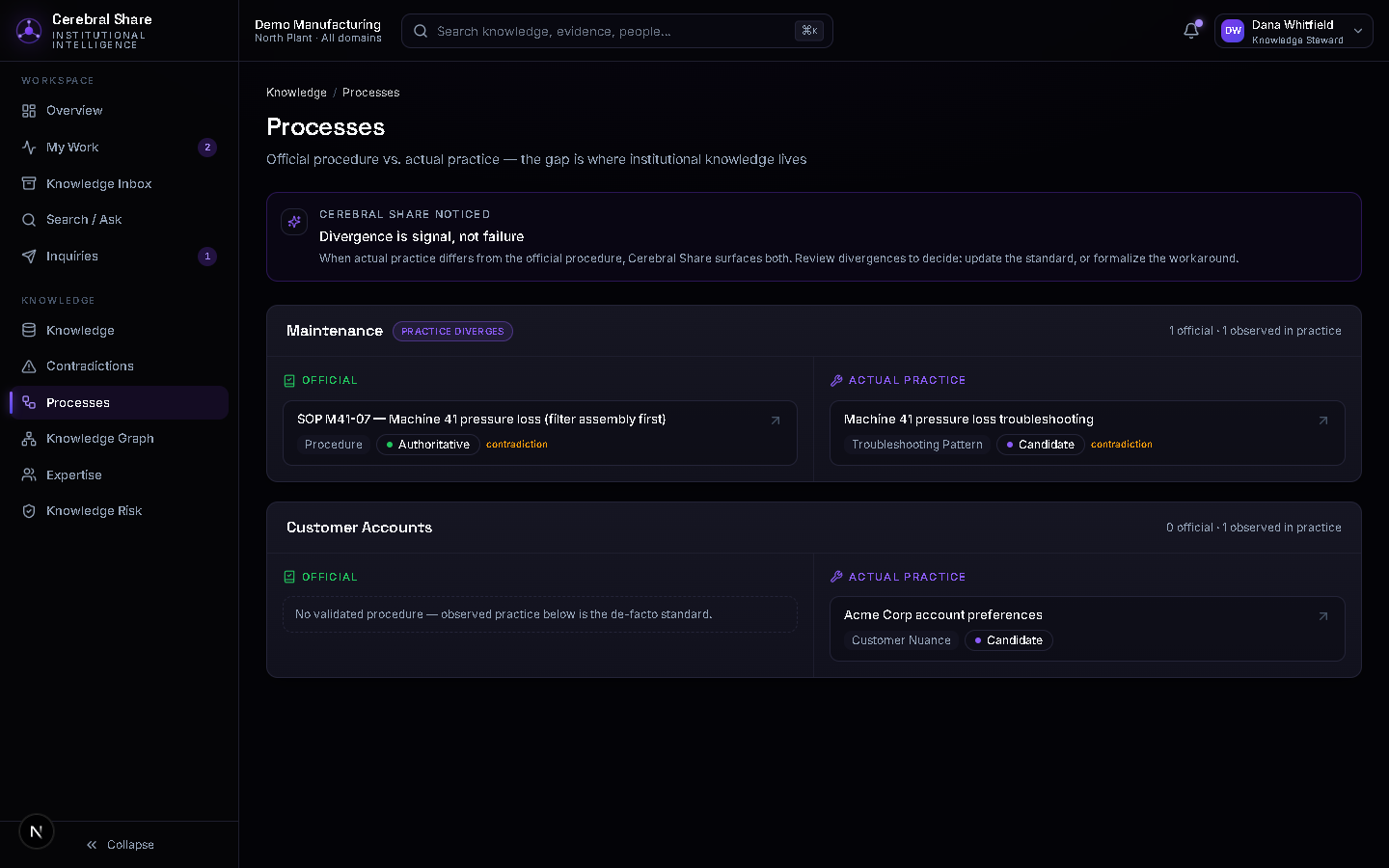
See when the organization does not have one answer
Official procedure versus actual practice. One location versus another. Old documentation versus newer evidence. Cerebral Share surfaces the divergence instead of hiding it.
When sources disagree, both interpretations remain visible with their evidence, so accountable people can decide: update the standard, or formalize the workaround.
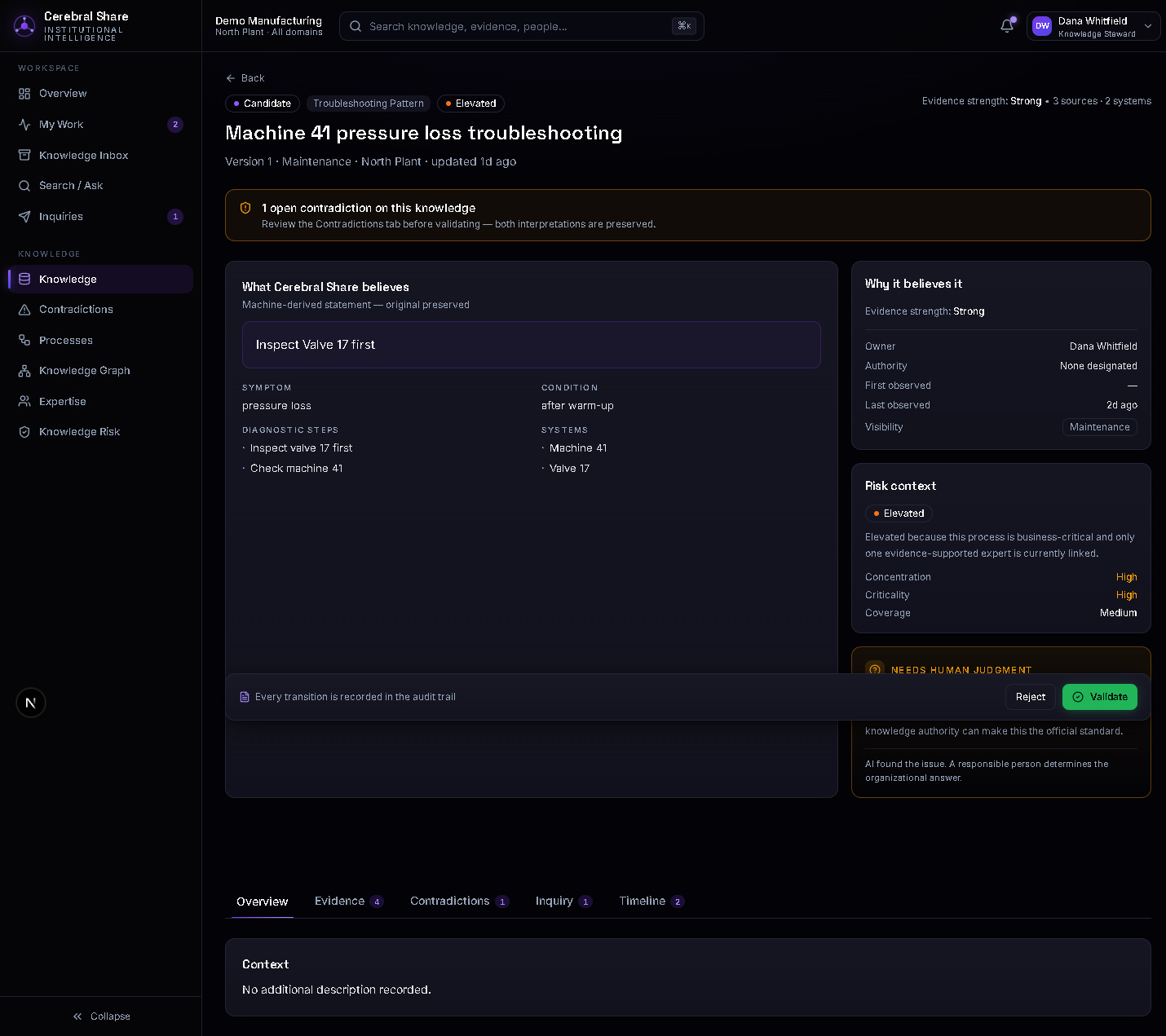
AI proposes. Responsible people decide.
Candidate knowledge is not company truth. Every candidate carries its evidence, its conflicts, and its review state — and waits for a human decision.
Subject matter experts get focused, evidence-backed questions instead of blank-page documentation. Knowledge authorities determine what becomes validated or authoritative. Every transition is recorded.
Turn meetings into reusable intelligence
Approved meeting material can become structured, reusable intelligence: decisions, action items, risks, questions, commitments, and evidence-linked summaries.
Permission-aware briefs can help deliver relevant intelligence to executives, operations, risk, quality, customer, and technical teams — so decisions and commitments do not disappear into forgotten transcripts and notes.
Decisions, commitments, and questions — linked to their evidence
Keep the intelligence that matters current
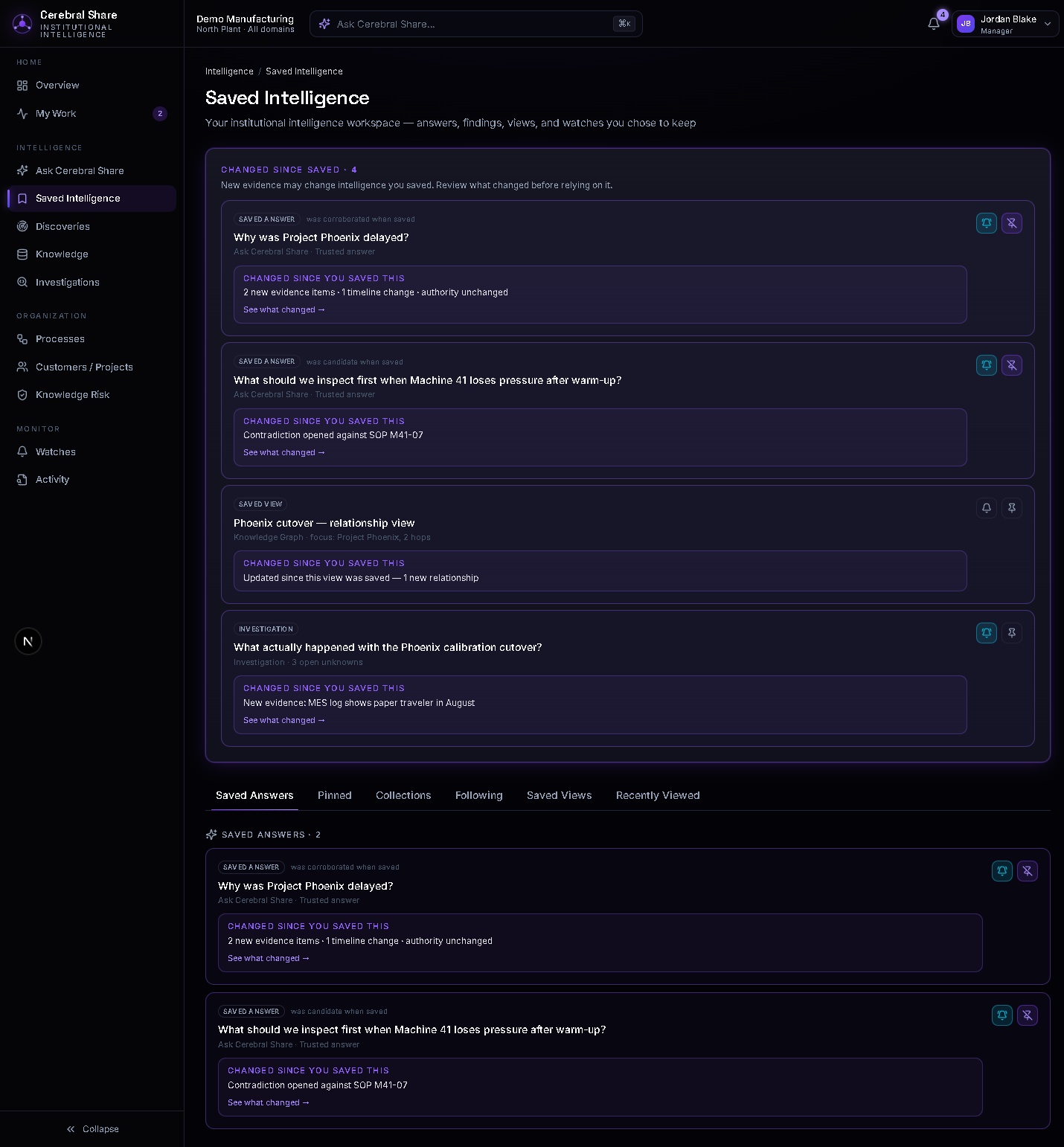
Save important intelligence, follow key knowledge, and organize findings into collections built around the work you are responsible for.
See when important intelligence has changed since you last reviewed or saved it, receive relevant notifications, and maintain knowledge history as new evidence appears.
Everything your organization needs to govern knowledge.
Validate with Human Authority
AI proposes. Responsible people determine what becomes validated or authoritative.
Find Contradictions and Process Drift
Surface situations where procedures, locations, teams, or experienced people describe the same work differently.
Understand Knowledge Risk
Help leaders see where critical knowledge appears concentrated, stale, weakly supported, or dependent on too few sources.
Search Trusted Knowledge
Make it easy for authorized people to find the best available answer and understand its status.
Maintain Knowledge Over Time
Keep history and trigger reassessment when new evidence conflicts with what was previously trusted.
Deliver Knowledge Where Used
Make validated knowledge available to approved organizational workflows and systems.
Connect Fragmented Business Context
Designed to relate evidence across approved sources instead of treating every file, message, meeting, or ticket as an isolated search result.
Reconstruct Decisions
Understand what appears to have been decided, who participated, what evidence surrounded the decision, why it was made, and whether later evidence changed the outcome.
Understand Plans Versus Outcomes
A plan is not the same as an implementation. Compare what was intended with what later evidence suggests actually happened.
Follow Organizational Timelines
See how decisions, documents, conversations, incidents, projects, and process changes developed over time.
Surface Unresolved Context
Find important questions, commitments, contradictions, or plans that appear to lack a clear conclusion.
Preserve Continuity When People Leave
See which customers, processes, projects, decisions, troubleshooting knowledge, and unresolved work may rely heavily on context associated with a small number of people.
Explain the Connections
Important relationships remain traceable to source evidence, so users can understand why two pieces of organizational context are connected.
The things businesses lose are rarely limited to procedures.
Decision Rationale
Why did we choose this approach?
Unfinished Plans
What was supposed to happen but may never have been completed?
Customer Context
Which promises, exceptions, preferences, and historical decisions matter?
Process Reality
What do people actually do compared with what the procedure says?
Troubleshooting Knowledge
What diagnosis exists in conversations and work history but nowhere formal?
Project History
How did the project evolve, and what changed?
Unresolved Work
What questions, commitments, or issues appear to have no clear closure?
Continuity Risk
What context becomes difficult to reconstruct if a key person leaves?
Not another knowledge base.
A file repository
Stores information. Does not tell you what matters, what conflicts, or what is missing.
Enterprise search
Locates information. Does not validate it, govern it, or show you the risk of losing it.
A wiki
Depends on someone writing and maintaining it. Often outdated before it is finished.
A chatbot
Answers questions from what it can retrieve. Does not distinguish trusted knowledge from noise.
Cerebral Share
Discovers what may be durable institutional knowledge, preserves evidence, resolves uncertainty through people, maintains authority, and understands where knowledge itself creates organizational risk.